Foreign Travel Reporting Requirements
Traveling outside the United States can expose U.S. citizens to increased risks, including potential targeting—even in low-risk destinations. Taking appropriate precautions is essential to maintaining safety and awareness.
In accordance with Security Executive Agent Directive 3 (SEAD 3), certain personnel—referred to as “covered individuals”—are required to comply with foreign travel reporting requirements, designed to protect personnel, organizations, and national security interests.
All foreign travel by covered individuals is subject to pre- and post-travel reporting requirements, regardless of whether the travel is personal, business related, government contract related, or for any other reason.
Who Foreign Travel Reporting Applies To
“Covered individuals” are required to report foreign travel.
Covered individuals include personnel designated by their agency or organization who, due to their role, access, or affiliation, are subject to foreign travel reporting requirements under SEAD 3. This may include, but is not limited to, individuals with access to classified information, sensitive information, systems, or facilities.
Employees, consultants, and contractors supporting organizations that perform work for the U.S. Government may be designated as covered individuals and therefore subject to foreign travel briefing and reporting requirements.
If you are unsure if you are considered a covered individual, it is your responsibility to contact your Facility Security Officer (FSO) for clarification.
Before You Travel: Pre-Travel Briefing & Reporting
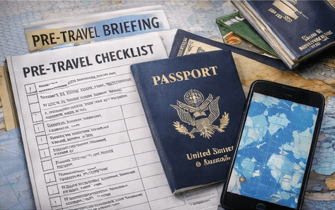
Covered individuals are required to report any planned foreign travel in advance of departure.
Whenever possible, you should notify your FSO at least 30 days in advance. This allows sufficient time for your security team to assess potential risks, provide country-specific guidance, and coordinate any required briefings prior to travel.
What must be reported:
All travel outside the U.S., including to Canada and Mexico, regardless of purpose.
Required Actions:
- Notify your Facility Security Officer (FSO) at least 30 days in advance of departure, whenever possible.
- Complete any required pre-travel briefings.
- Complete all required pre-travel reporting forms.
- Submit your travel itinerary through the appropriate channels designated by your organization.
- Review applicable travel advisories or restricted country lists.
- Ensure your contact and emergency information is current.
- Report any changes to your travel itinerary to your FSO as soon as possible.
Additional approvals or briefings may be required depending on destination risk level or duration of travel, particularly for high-threat locations.
Special Circumstances:
- Border travel (Canada and Mexico): Planned travel must still be reported prior to departure. Unplanned or short notice travel must be reported within five (5) days of return.
- Overseas assignments: If you are assigned or stationed outside the United States, travel outside your country of assignment must be reported in accordance with these requirements.
- Transits / layovers: Travel that includes layovers or transit through a foreign country is reportable foreign travel.
- Cruise travel: Cruises that visit foreign ports are considered reportable foreign travel, regardless of whether you disembark.
- Extended stays or repeated travel: Each instance of foreign travel must be reported, including repeated or short-duration trips.
- Dual citizenship / foreign residency ties: Travel to a country of dual citizenship or prior residence remains subject to reporting requirements and must be conducted using a U.S. passport in accordance with applicable requirements.
- Family or personal visits abroad: Travel to visit family, relatives, or personal contacts in a foreign country is reportable foreign travel.
While Traveling: Stay Alert
While outside the United States, you are expected to maintain a heightened level of awareness.
Key considerations:
- Do not disclose classified, sensitive, proprietary, or controlled information.
- Do not bring government-furnished or organization-issued equipment without prior written authorization from the appropriate authority.
- Limit use of government-issued or work devices unless specifically authorized.
- Be cautious with all electronic devices. Treat foreign networks and systems as potentially unsecure and assume they may be subject to monitoring or compromise.
- Be alert to and disengage from suspicious interactions or inquiries. Report any suspicious contacts or incidents as soon as feasible.
- Comply with all local laws while continuing to meet U.S. security expectations.
- Report any changes to your travel itinerary to your Facility Security Officer (FSO) as soon as possible.
After You Return: Post-Travel Reporting
Post-travel reporting and debriefing is a critical component of SEAD 3 compliance. Covered individuals are expected to report their return from foreign travel within 72 hours of arrival in the United States.
Timely post-travel reporting is required and is just as important as pre-travel reporting.
You are required to:
- Complete a foreign travel debrief or report.
- Confirm return from foreign travel within required reporting timelines.
- Confirm that no government-furnished, organization/company-furnished, or personal devices, systems, or credentials were compromised during travel or as a result of foreign contact.
- Submit any required post-travel documentation or reporting forms through the appropriate security channel.
You are required to report any notable or unusual incidents, including (but not limited to):
- Questioning by foreign officials beyond normal customs or immigration procedures.
- Attempts to elicit classified, sensitive, or controlled information.
- Attempts to elicit information under casual, social, or indirect pretexts.
- Attempts by foreign nationals to establish ongoing contact.
- Casual conversations that evolve into questions about job, access, or organization details.
- New relationships (of any nature) with foreign nationals with whom you intend to maintain ongoing contact.
- Offers of gifts, favors, or incentives.
- Any interaction that was suspicious, persistent, caused concern, or appeared out of the ordinary.
- Indicators of surveillance, monitoring, or being followed during travel.
- Suspicious observation, photography, recording, or documentation of you or your activities.
- Device anomalies or unexpected device behavior, such as unexplained resets, new apps, signs of tampering, loss of device control, forced login prompts, or unexpected lockouts.
- Unusual financial interactions or inducements, suspicious payments, reimbursements, or attempts to engage you in financial arrangements.
- Attempts to coerce, pressure, intimidate, blackmail, or influence behavior or decision-making during or after travel.
- Any travel disruption or interference that appears intentional or unusual.
Timely and accurate post-travel reporting enables security personnel to assess potential risk indicators and take appropriate mitigation actions.
Why Foreign Travel Briefing and Reporting Matters
Foreign travel can increase the risk of targeting by foreign intelligence services, as well as exposure to foreign intelligence collection, exploitation, or coercion. Reporting requirements under SEAD 3 are intended to reduce these risks and ensure appropriate support if issues arise.
Reporting foreign travel also plays an important role in personal safety. In the event of natural disasters, civil unrest, or other emergencies abroad, having your travel on record allows your organization to quickly account for your location and provide assistance if needed. This enables faster coordination of communication, support, and, when necessary, evacuation.
These requirements are not just procedural—they are designed to safeguard personnel and national security.
Failure to comply with reporting obligations may result in administrative or security-related action and could impact your security clearance or eligibility to perform on government contracts.
If you’re unsure whether your travel needs to be reported, contact your FSO or security team before making plans. Reporting travel in advance ensures the appropriate briefing and reporting requirements can be identified and applied to your specific circumstances.
Staying informed and meeting reporting requirements helps reduce risk and ensures appropriate support is available when it matters most.
Resources and Additional Learning
- CDSE Foreign Travel Defensive Briefing
- DCSA Self-Reporting
- Reporting Requirements at a Glance
- NISP Reporting Requirements
- SEAD 3 – Reporting
- SEAD 3 Short
- SEAD 3 Toolkit
- Foreign Contact – What is Reportable
- What to Report – Suspicious Contact
- CDSE Case Studies
- Security Awareness Games
- 32 CFR Part 117 (NISPOM Rule)
- 32 CFR Part 147 (Adjudicative Guidelines)
As always, if you have any questions, ask your FSO. Your company’s FSO is the best person to help you navigate any questions you have about security compliance, briefing, and reporting requirements. As security professionals, we are here to help you navigate all things security and ensure you fulfill all security requirements.